
How to Move From JEE Main Preparation to JEE Advanced Preparation
Clearing JEE Main is an important milestone, but preparing for JEE Advanced requires a different approach. While both examinations test your understanding of Physics, Chemistry and Mathematics, JEE Advanced places greater emphasis on conceptual depth, analytical thinking and the ability to solve unfamiliar and multi-concept problems.
Students who have been preparing for JEE Main should not simply increase the number of questions they solve. Instead, they need to gradually change how they study, practise and analyse problems.
The transition from JEE Main to JEE Advanced preparation is about moving from speed-focused practice to deeper problem-solving and application of concepts.
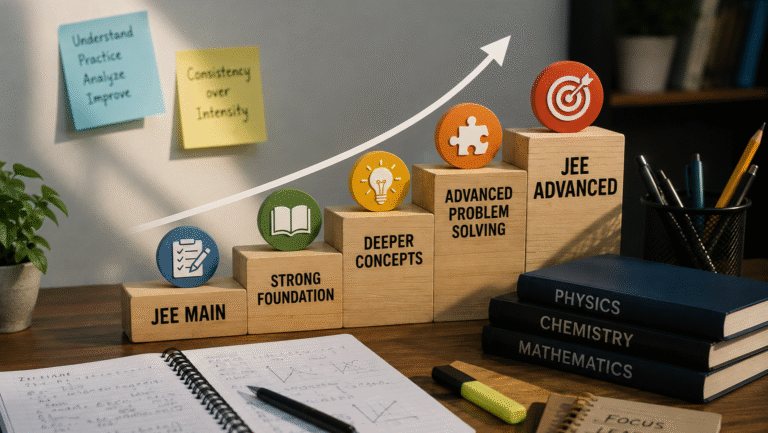
JEE Main vs JEE Advanced: What Changes?
The biggest mistake students make during this transition is assuming that JEE Advanced is simply a more difficult version of JEE Main.
There are important differences in the way students need to approach the two examinations.
JEE Main
JEE Main preparation generally focuses on:
-Strong understanding of fundamental concepts
-Formula application
-Speed and accuracy
-Previous-year questions
-Time management
-Regular mock tests
-Covering the required syllabus efficiently
JEE Advanced
JEE Advanced preparation requires additional focus on:
-Deeper conceptual understanding
-Multi-concept problems
-Logical reasoning
-Analytical thinking
-Unfamiliar question formats
-Connecting concepts across chapters
-Solving challenging problems without relying on familiar patterns
Therefore, your preparation strategy should evolve once your JEE Main foundation becomes strong.
1. Strengthen Your Conceptual Understanding
The first step in JEE Advanced preparation is to build a strong understanding of the fundamental concepts. Instead of simply memorising formulas, focus on understanding why they work, when they should be applied and how different concepts are connected.
JEE Advanced often presents familiar concepts in unfamiliar situations. A strong conceptual foundation helps you approach these problems logically rather than depending only on memorised formulas. Spend time revising your fundamentals and gradually practise questions that require you to apply those concepts in different ways.
2. Move Beyond Routine Questions
JEE Main preparation often involves solving questions based on familiar concepts and patterns. As you move towards JEE Advanced preparation, you need to become comfortable with questions that require deeper thinking and multiple steps.
Start including challenging problems that combine concepts from different chapters. Don't worry if these questions take longer to solve initially. The goal is to understand the approach and develop the ability to break a difficult problem into smaller, manageable parts.
3. Develop a Different Problem-Solving Approach
JEE Advanced requires more than knowing which formula to use. Before starting a problem, take a moment to understand what is being asked and identify the concepts that may be involved.
Try to think about possible approaches before beginning your calculations. If the problem looks complicated, break it into smaller steps and check your assumptions along the way. This habit can help you become more comfortable with unfamiliar questions.
4. Use Your JEE Main Preparation as a Foundation
Your JEE Main preparation gives you a valuable foundation for JEE Advanced. By this stage, you may already have covered most of the syllabus, practised previous-year questions and taken mock tests.
Instead of starting again from the beginning, identify the areas where you need improvement. Chapters that you understand well can be taken to a higher level through advanced problems, while weaker areas may require additional revision before you move to more difficult questions.
5. Change the Way You Use Previous-Year Questions
Previous-year questions are useful for both JEE Main and JEE Advanced, but they should not be treated simply as questions to complete.
When practising JEE Advanced questions, spend time understanding why a particular approach works. After solving a problem, think about whether there is another method, which concepts were connected and what made the question challenging.
This type of analysis can turn a single question into a much more valuable learning experience.
6. Practise Multi-Concept Problems
One of the major changes when moving from JEE Main to JEE Advanced is the need to connect concepts.
An Advanced-level question may require you to use ideas from more than one topic. Once your fundamentals are strong, start including mixed-topic problems in your practice instead of studying every chapter completely in isolation.
This will gradually improve your ability to recognise connections between concepts and decide which principles are relevant to a particular problem.
7. Improve Your Mathematical Thinking
JEE Advanced Mathematics requires more than remembering formulas. You need to develop the ability to identify patterns, make logical deductions and explore different approaches to a problem.
If you cannot solve a difficult question immediately, don't rush to the solution. Spend some time trying different approaches and understanding where you are getting stuck. Even when you don't reach the final answer, analysing your attempt can improve your problem-solving ability.
8. Strengthen Physics Through Concepts
For Physics, focus on understanding the physical principles behind the equations rather than memorising formulas alone.
When studying a topic, ask yourself what is actually happening physically and why a particular equation can be used. Pay attention to derivations, graphs, numerical problems and situations where multiple concepts are combined.
This deeper understanding becomes particularly useful when JEE Advanced presents a familiar concept in an unfamiliar situation.
9. Build Strong Chemistry Fundamentals
Chemistry requires a balanced approach to Physical, Organic and Inorganic Chemistry.
In Physical Chemistry, focus on understanding concepts and applying equations through regular numerical practice. For Organic Chemistry, develop a clear understanding of reaction mechanisms and the relationships between different reactions. In Inorganic Chemistry, focus on conceptual understanding, important trends and systematic revision.
Rather than trying to memorise everything separately, look for connections between concepts and revise them regularly.
10. Maintain Your JEE Main Skills
Preparing for Advanced doesn't mean completely stopping JEE Main practice. Continue revising important formulas and practising standard questions so that you maintain your speed and accuracy.
Final Thoughts
The transition from JEE Main to JEE Advanced is about changing the way you approach problems. Build on your existing fundamentals, practise deeper questions, analyse your mistakes and gradually become comfortable with unfamiliar problems.
A consistent JEE Advanced preparation strategy can help you develop the conceptual clarity and problem-solving skills needed to perform confidently in the examination.
Frequently Asked Questions
1. Is JEE Advanced preparation different from JEE Main preparation?
Yes. JEE Advanced requires greater conceptual depth, analytical thinking and problem-solving ability, while JEE Main places more emphasis on speed, accuracy and strong fundamentals.
2. When should I start JEE Advanced preparation?
You can start Advanced-level preparation once your JEE Main fundamentals are strong. It is beneficial to gradually introduce Advanced-level questions rather than waiting until the last stage.
3. Should I stop JEE Main preparation when preparing for Advanced?
No. Continue practising JEE Main-level questions to maintain speed and accuracy while adding more challenging Advanced-level problems.
4. How can I improve my JEE Advanced problem-solving skills?
Practise different types of problems, analyse your mistakes and focus on understanding the concepts behind each solution rather than memorising answers.
5. Are mock tests important for JEE Advanced preparation?
Yes. Regular mock tests help you understand your strengths and weaknesses while improving time management, question selection and exam confidence.
6. What is the biggest change from JEE Main to JEE Advanced?
The biggest change is the level of conceptual application. JEE Advanced often requires students to connect multiple concepts and solve unfamiliar problems rather than directly applying a familiar formula.
With the right guidance and a structured approach, the transition from JEE Main to JEE Advanced can become a strong opportunity to take your preparation to the next level. Start building deeper concepts, practise smarter and stay consistent throughout your preparation.
Enroll Now